Joanne Roach (00:13)
Hello and welcome to the Food for Kids podcast. I'm Joanne from the Foodies. This episode is designed to give you some information to help you explore the colours of fruits and vegetables with kids.
The idea of eating a rainbow has been around for a long time and you probably know that each colour brings something different to your table and your health, but do you know which ones have which benefits? In a way, it doesn't really matter because reducing our diet down to individual components or individual foods isn't helpful. Our bodies are incredibly sophisticated and foods are more than the sum of the parts that we can isolate in the laboratory. The underlying principle of trying to eat a rainbow will do more to help our overall well-being than any one individual chemical in any one pigment in any one food group.
But I do think it's often fun to know more about food in order to understand how rich and clever nature is and how smart our bodies are. And when trying to explain things to children, it's often nice to have a few facts to talk about. So for each of the rainbow food colours, I'm going to tell you what the properties are that are associated with that food colour and the ways that we know they are helpful to our health. And I'll also suggest a fun fact to give to kids if they're interested in exploring foods.
It's important that we don't preach to kids about health benefits of foods in some kind of attempt to make them eat more of something that they don't currently want. But just learning about foods without any pressure to eat them can build their familiarity and their confidence.
On a general note on all of the foods before I start, all of those fruits and veggies contain a huge array of beneficial things, but I'll highlight how some of the colours are good for providing different vitamins, minerals and antioxidants. Antioxidants is a word that gets bandied around a lot, but they are basically compounds that often help to reduce unnecessary cell damage in the body.
Our bodies are incredibly clever and complex and they can use lots of different chemicals from lots of different sources to build what they need. So always try to not get down into the weeds on individual compounds, but instead try to look at the overall picture and giving your body a mix of different tools so it can get on with doing its job.
I will link to some articles in the show notes which talk about this in more detail if you're interested in some of the science, but I'm going to keep the information for each colour quite short. So it's just a bit of fun to have some wonder about what our foods can do. So here we go.
Let's start with red foods. Red foods like tomatoes, red peppers, watermelon and pink grapefruit contain an antioxidant called lycopene. Diets rich in lycopene are linked to a whole load of protective benefits from cardiovascular health and blood pressure, lowered cholesterol and reduced risks of some cancers. These foods are also great sources of vitamin C. For example, a red bell pepper has more vitamin C than an orange. But rich red foods really are a great source of lycopene.
A fun fact is that it's easier for us to absorb lycopene in cooked tomatoes than in raw ones. So this is great because we can help children to understand that eating raw tomatoes on their salads and snacks gives us one lot of help for our body. But when we eat tinned tomatoes, pizza sauce, pasta sauce, tomatoes cooked in olive oil or tomato puree, we're getting a different kind of help from those tomatoes. So if your child isn't sure about raw tomatoes yet, as a lot of children aren't because of the squeaky skin and the seeds and the different textures, but they will eat them cooked in any of those sauces, then you can tell them they're still doing something great for their bodies.
Some other red fruits like strawberries, raspberries and cherries contain good amounts of something called anthocyanin but that's also found a lot in purple food so I'll talk about anthocyanin there. So that's red foods.
Orange fruits and vegetables like carrots, apricots, orange peppers, sweet potatoes, pumpkins are rich in beta-carotene which is something that the body converts into vitamin A when it needs it. Vitamin A supports healthy vision, so that's where we got that slightly exaggerated story we were told as kids that carrots can help you see in the dark. But it does also help the immune system and our skin too.
A fun fact about carrots is that they used to be purple and over many years we bred them to be more orange. We think this started in the Netherlands in around 1600 to 1700 when they combined carrot plants that were sweeter and tastier, which also happened to be paler and more yellow or white. They were trying to make tastier carrots and over time the colour also became orange. You can still get seeds for purple carrots now, or some that are even purple on the outside and orange on the inside.
Now for yellow foods. Yellow foods like corn, yellow peppers and some yellow squashes also contain beta-carotene, but they're also quite rich in a different kind of carotene called lutein, which is very helpful for protecting the eye against light damage and it also protects against some age-related eye damage.
A fun fact about corn is that each of the little kernels in a corn on the cob has to be fertilised individually. There are little tassels that come out of the top of the cobs when they're growing and those tassels are made up of lots of silky strands. Each of those strands leads directly to one kernel. So that's why you sometimes have empty spaces on a corn cob is because that strand didn't get fertilised.
OK, now green plants. Green plants usually get their colour from a substance called chlorophyll, but the health benefits of green veggies usually come from some of the other nutrients they contain. Leafy greens like spinach, kale, collards and cabbages, as well as other green foods like courgettes, leeks, broccoli, green beans and cucumbers are excellent sources of vitamin K which helps our blood to clot but they're also packed with vitamins A, B, C and E as well as iron, calcium and magnesium.
A fun fact about green veg is that the chlorophyll in those green plants is the thing that helps the plants to grow with a process called photosynthesis as we all learned about in school. So that chlorophyll is a bit like an internal solar panel because it helps them to turn sunlight into energy for them to use.
OK, let's move on to the blue and purple category. Blue and purple fruits and vegetables like blueberries, blackberries, red or purple cabbage and aubergine skins get their colour from compounds called anthocyanins, which are anti-inflammatory and they're linked to reducing our risk of cardiovascular issues and some cancers. As I mentioned before, some red fruits like raspberries also have a lot of this in them, so if your child isn't keen on blueberries, they could have some raspberries instead. Purple foods also have lots of other vitamins in them too.
A fun fact is that purple and blue foods have often been used as natural dyes for fabrics throughout history, and anthocyanin will even change colour if it is added to acid or alkaline solutions. So if you add lemon juice to some red cabbage juice it will go pink, and if you add bicarbonate of soda to it, it will go blue.
And then our last group is our white or beige foods like onions, garlic, mushrooms and cauliflower. These foods are not dominated by a colourful pigment, but like all vegetables they still contain important compounds, example, allicin in garlic and onions which is linked to supporting our immune system as well as helping to lower cholesterol and blood pressure.
Mushrooms contain D vitamins and a fun fact about mushrooms is that they can absorb more vitamin D from sunlight. So if you put your mushrooms in a sunny spot for 15 minutes or so before cooking them, they can increase the levels that you take in.
So that's a fun run through of things to know about different colours of foods.
But the important thing to remember and also to help children to understand is that no one individual food or colour of food or ingredient or compound is more important than anything else. The plants that we eat have evolved over thousands or in some cases millions of years to be the complex living things that they are now. And lots of the things that are good for us in those plants are things that they evolved in order to survive, for example, to ward off predators or to attract pollinators. In turn, we have evolved alongside them to be able to benefit from those properties that the plants have. Human bodies, just like the rest of the natural world, are constantly fine-tuning themselves to adapt to the world around them. And because humans live in all kinds of different places, we've become adapted to eat foods from a wide variety of sources.
So if we just focus on variety and abundance instead of zeroing in on specific good or bad foods, we are working with our bodies provide a range of different ingredients for all the different parts of their body to do their job.
There is a good body of evidence that shows that if you can eat around 30 or more different plants over the course of the week, that includes herbs and spices by the way, you can gain a lot of benefit for overall health. And if you're not in a place right now in your family's life cycle where that feels at all achievable, then instead shooting for eating a range of different colours is a really good way to go.
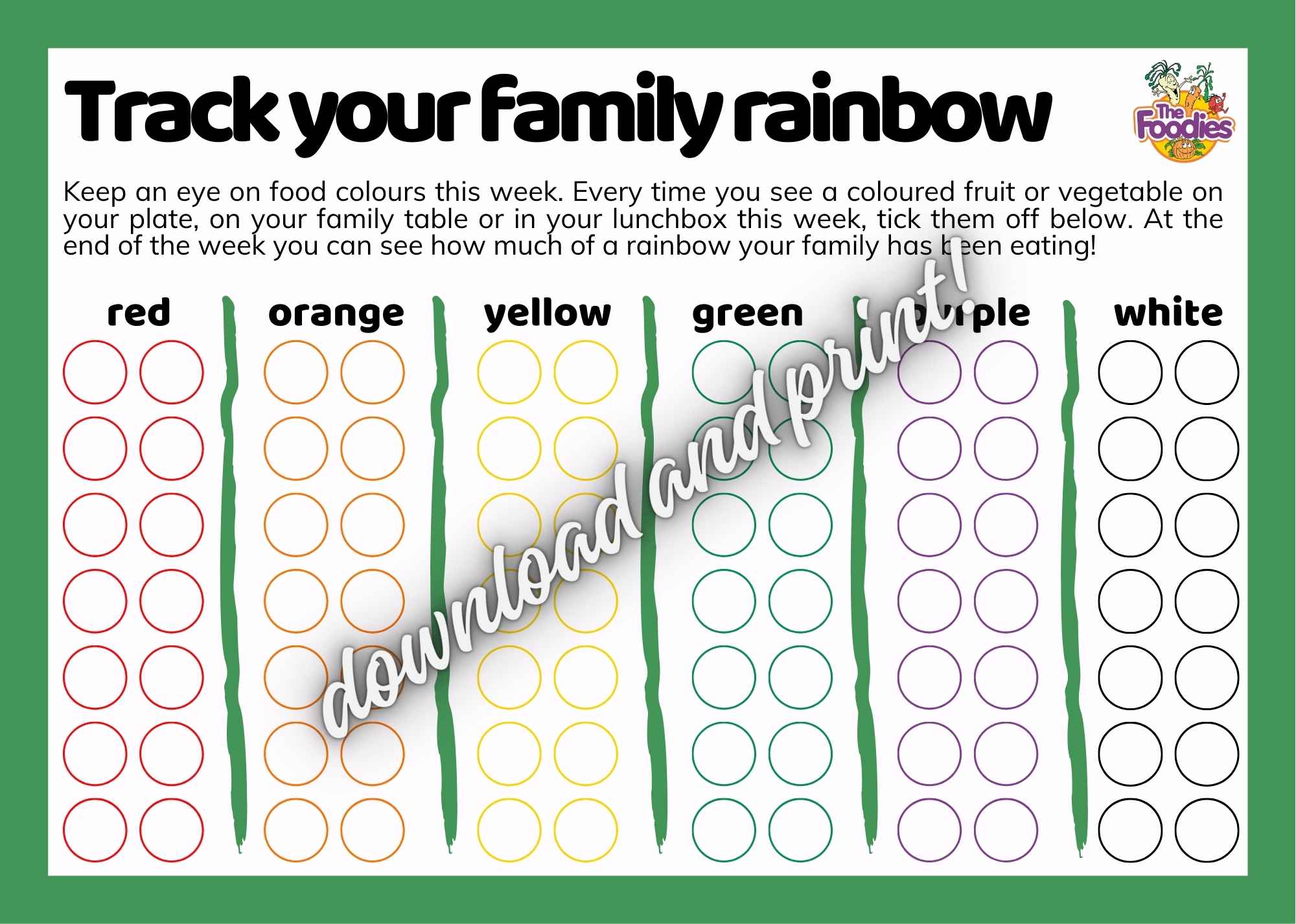
I don't know about you, but I love a chart. I love ticking things off. I like getting gold stars. And while rewards for individual eating is not always a good idea, it can often backfire, especially for hesitant children. It is sometimes fun to try and achieve a goal together as a family. So why not try as a family to buy at least one fruit or veg from each colour on the weekly shop and then try to eat them during the week? Your child doesn't have to eat any or all of the foods if they're hesitant, but they can help you pick them out. They can help you to find ways to eat them by looking in recipe books or online, and they can help you to prep or serve some of them. And they can help you tick off on a chart when each colour has appeared at the table or in a lunch box, even if they're not eating the foods themselves yet.
To help with this, I'll put a very simple printable in the show notes for a food colours chart that you can work together in whatever low pressure way works for your family. Even if your child just comes up with ideas for each category or researches them online so that you have ideas to work with, it's all building familiarity. And remember that most foods contain a range of vitamins and minerals and they all contain different types of fibre which is so helpful to our guts. And most importantly of all, they can all add different tastes and a bit of joy to our plates and to our lives in lots of different ways and in different combinations with each other. So download your printable and go and find some different colored fruit and veg to explore together.
I hope you found this fun. As I said, I'll put a bunch of links in the show notes for more information about colours in foods and some fun stuff for kids too. The main thing is to just build their education and knowledge without them feeling any expectation to eat things until they choose to. The building of knowledge is a legitimate step on their eating journey and it all helps to make them into a confident eater.
So enjoy shopping for some colourful produce and I hope to see you on the next episode. In the meantime, happy red, orange, yellow, green, purple and white eating.



0 comments